Archives
- 2026-06
- 2026-05
- 2026-04
- 2026-03
- 2026-02
- 2026-01
- 2025-12
- 2025-11
- 2025-10
- 2025-09
- 2025-03
- 2025-02
- 2025-01
- 2024-12
- 2024-11
- 2024-10
- 2024-09
- 2024-08
- 2024-07
- 2024-06
- 2024-05
- 2024-04
- 2024-03
- 2024-02
- 2024-01
- 2023-12
- 2023-11
- 2023-10
- 2023-09
- 2023-08
- 2023-07
- 2023-06
- 2023-05
- 2023-04
- 2023-03
- 2023-02
- 2023-01
- 2022-12
- 2022-11
- 2022-10
- 2022-09
- 2022-08
- 2022-07
- 2022-06
- 2022-05
- 2022-04
- 2022-03
- 2022-02
- 2022-01
- 2021-12
- 2021-11
- 2021-10
- 2021-09
- 2021-08
- 2021-07
- 2021-06
- 2021-05
- 2021-04
- 2021-03
- 2021-02
- 2021-01
- 2020-12
- 2020-11
- 2020-10
- 2020-09
- 2020-08
- 2020-07
- 2020-06
- 2020-05
- 2020-04
- 2020-03
- 2020-02
- 2020-01
- 2019-12
- 2019-11
- 2019-10
- 2019-09
- 2019-08
- 2019-07
- 2019-06
- 2019-05
- 2019-04
- 2018-07
-
br Acknowledgements This work was financially supported
2021-12-07
Acknowledgements This work was financially supported by the National Natural Science Foundation of China (Grant No. 81803033) and the “Double First-Class” University project (CPU2018GF02). Introduction Atrial fibrillation (AF) is the most common progressive cardiac rhythm disorder. Studies ha
-
enfuvirtide In summary P P macrocyclization proved to be an
2021-12-07

In summary, P2-P4 macrocyclization proved to be an effective strategy to drive activity in this series of HCV NS3 protease inhibitors while microsomal stability was enhanced by the introduction of steric bulk along the tether. This modification augmented the previously-described tactic of improving
-
A similar symbiotic relationship has been reported in the br
2021-12-07
A similar symbiotic relationship has been reported in the brain, where increased gradients of lactate secreted by astrocytes enables neurons to import and use this nutrient, a process referred to the ‘neuron–astrocyte lactate shuttle’ [16]. Similarly, lactate-based metabolic coupling established by
-
The physiological and pharmacological roles of GPR remain la
2021-12-07
The physiological and pharmacological roles of GPR81 remain largely unclear because of several reasons. The low potency of lactate agonizing GPR81 in the millimolar range, together with its fast metabolic turnover, renders as a challenge in in vivo studies using lactate. Furthermore, there are no po
-
Based on the results of
2021-12-07
Based on the results of , 91 5 synthesis appeared to have the best overall profile, so our efforts were then devoted to using 5-(-propyl)pyrimidine as the right-hand nitrogen attachment to optimize the R group of (). Analog was synthesized using the reaction conditions from , while analogs and
-
In our study we evaluated adenovirus type Ad
2021-12-07
In our study we evaluated adenovirus type 5 (Ad5) as a vehicle for delivering Cre recombinase in conditional transgenic mouse based on the Cre-loxP system, in order to achieve GlyT1 gene modulation in a specific thalamic region in the adult animal. GlyT1 is a sodium- and chloride-coupled glycine tra
-
Glutamate activates cationic glutamate gated channels i e io
2021-12-07
Glutamate activates cationic glutamate-gated channels (i.e. ionotropic glutamate receptors) that mediate the fast excitatory actions of glutamate. It also activate G protein-coupled receptors, named metabotropic glutamate receptors (mGluRs) (Pin and Bettler, 2016). The eight subtypes of mGluRs are k
-
br Do the actions of
2021-12-07
Do the actions of GLP-1R agonists on the vascular endothelium account for GLP-1R agonist-mediated cardioprotection? The previous section highlighted the recent clinical evidence from cardiovascular outcomes studies supporting the notion that GLP-1R agonists confer cardioprotective actions in pati
-
GOAT belongs to the super family of membrane bound
2021-12-07
GOAT belongs to the super family of membrane-bound O-acyltransferases (MBOATs). It is encoded by the gene MBOAT4 in human. The protein GOAT is highly conserved from zebrafish to human (Yanagi et al., 2018). GOAT is ubiquitously expressed with abundant expression in the stomach and intestine (Sakata
-
There is increasing evidence that Cxs in astrocytes may play
2021-12-07
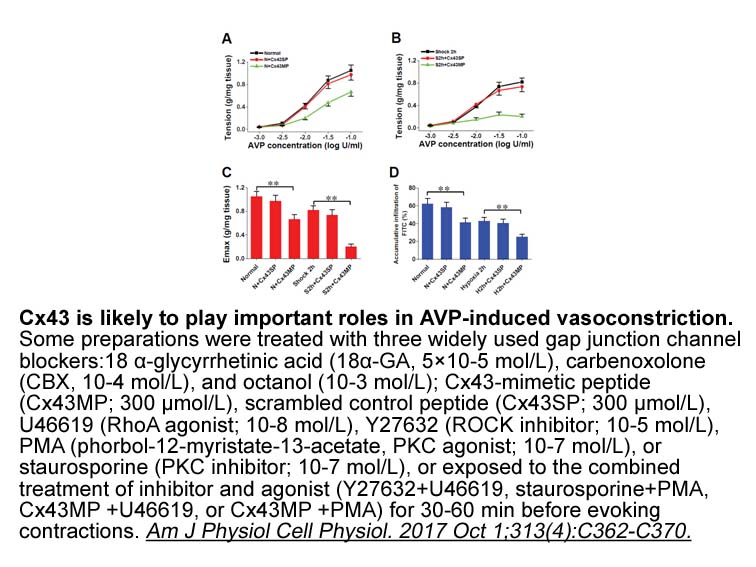
There is increasing evidence that Cxs in astrocytes may play a role in several models of brain pathologies. Interestingly their roles are at the moment more considered through their hemichannel function (Bennett et al., 2012; Bosch and Kielian, 2014; Davidson et al., 2013; Orellana et al., 2016; Kim
-
br Results br Discussion secretase mediated proteolysis of
2021-12-07
Results Discussion γ-secretase-mediated proteolysis of integral membrane proteins is required for diverse biological processes (Lal and Caplan, 2011). One γ-secretase target of particular interest is Notch, as recent work has shown Notch activity to be increased in obesity and associated metab
-
br Material and methods br Results br Discussion Propofol is
2021-12-06
Material and methods Results Discussion Propofol is commonly used in operation rooms or intensive care units (ICUs) for critically ill patients. Various clinical trials have demonstrated that the antioxidant, anti-inflammatory, and free-radical-scavenging properties of propofol can provide
-
Dextran sulfate sodium salt sale Based on this evidence futu
2021-12-06

Based on this evidence, future research should be directed towards the identification of actual receptor oligomeric states at the analyzed cellular surfaces. The macromolecular organization of these oligomeric receptors might establish informational hubs, which relay ligand/receptor interactions in
-
As illustrated in among all synthesized compounds biphenyl
2021-12-06

As illustrated in , among all synthesized compounds, biphenyl derivatives , , , , and with substitutions at the 3-position possessed the best FAAH inhibitory capacity. These 5 compounds demonstrated a good activity against FAAH with IC values in a submicromolar range. Nevertheless, when replacing t
-
SC-9 Lactate induced GPR activation was confirmed with a flu
2021-12-06
Lactate-induced GPR81 activation was confirmed with a fluorimetric imaging plate reader (FLIPR) assay, in which lactate induced a [Ca2+] flux in CHO cells stably expressing Gqi5 and HA-GPR81 but not vector control (Fig. 1C). The EC50 of lactate in the FLIPR assay was 4.3±0.73mM, a value well within
16251 records 572/1084 page Previous Next First page 上5页 571572573574575 下5页 Last page